Curriculum
CURRICULUM OUTLINE
Download PDF Version
Background:
This African and African American History Curriculum Outline was created to address the intentional erasure of Black history teachings from schools in Florida and nationwide. Black history is American history and should be taught all year, not just in February during Black History Month.
The Curriculum Outline's recommended content can be made age-appropriate and taught in K-12 core courses (e.g., ELA, science, math, social studies, history, etc.) and at every grade level. In addition, in this outline, our team emphasizes that Black history did not begin in the Americas but originated with the many Kingdoms and Queendoms in Africa, where humankind also began.
Our team developed the Curriculum Outline as a guide comprising factual accounts of historical events involving or directly impacting Black people for educators, both formally and informally trained, to use when teaching children – all children, not just Black children – about African and African American History.
The suggested content in the outline may be added to any Black History curriculum educators are currently using. Numerous Black History curriculum programs are available nationally for educators to use, so we are not endorsing any particular program. However, our team referred to a few programs to support our thinking as we curated the content for this outline, which is cited on our reference page at the end of this document.
1 This document uses the terms “African American” and “Black” interchangeably. Although our team believes that all Black people in the United States are descendants of Africa, we recognize and respect that Black people want to acknowledge their identities and connections to other ethnic backgrounds, such as the Caribbean Islands and South America. As such, we also use the word “Black” to include the myriad ethnic identities, cultures, and histories of the African Diaspora.
Introduction:
Imagine! You wake up in the middle of the desert, forgetting how you got there. You’re wondering about where you have been and who you are. Wouldn’t you want to know where you came from? Did you leave voluntarily, or were you taken? Were you alone, or were other people with you who dispersed to other places? The answers to these questions would be foundational knowledge for you to craft a vision to guide subsequent decisions toward your fate.
This is precisely the situation of our youth today. They are lost and are looking for direction. They are looking for answers about who they are. Where do they come from? How did they get here, and why? The answers to these questions are not only a layer of knowledge to build their value system. They are equally foundational to our youth’s ability to make quality decisions rooted in a vision to arrive at success.
Our youth, to make impactful decisions within a complex, ever-evolving, and multicultural society, need to be prepared to think critically, not only from their perspectives but from their community, national, and international perspectives. Especially in the Americas and the Caribbean, once called the New World, where their ancestors have been scattered and built nations and contributed immensely to humanity despite the obstacles and the negative narratives that mired their existence.
There needs to be an effective tool available to gather critical information, such as history, to assist educators in delivering an effectual concept of the decision-making process to youth and young adults of African descent. Too many Black youth and young adults are not making wise decisions due to a lack of access to factual historical and present-day information and appropriate and effective resources. Resources are not available to include knowledge of self, cultural pride and the process of decision making.
This product aims to be a tool for influencers of youth and young adults such as educators, Community Leaders, Youth Ministers, and parents. This tool will assist influencers in leading the youth (6th-12th grades) to obtain foundational knowledge to think critically during their life journey. The influencers need to moderate the language based on the maturity of the youth and grade level. The product has eight significant parts:
Part I - Learn about humankind beginning on the Continent of Africa
- Fossils of early human ancestors found in South African caves are considered 3.4 – 3.6 million years old, older than those previously found in Morocco and Ethiopia.
- Southern Africa is consistently placed as the region for the evolution of Homo sapiens. Using traditional and new science approaches, scientists estimate the first modern human population divergence between 350,000 and 260,000 years ago.
- Cradle of Civilization
Part II - Seven major African Kingdoms
Before slavery, their rise and fall within the context of Security, Economy, Diplomacy, Information, and Immigration) and where most of the New World Africans (NWA) came from.
- Dahomey Empire
- The Songhai Empire
- Ethiopian Empire
- Ghana Empire
- Ife Empire
- Hausa Empire
- Wolof Kingdom (Senegal)
- Kingdom of Kongo (Belgian atrocities in the Congo, Rwanda, Burunda; see King Leopold)
- Kush Empire (after 2000 years) became Nubia
- Egypt
- Kingdom of Zimbabwe
- The Partitioning of Africa: What was the Berlin Conference of 1884-1885
Part III - Christian empires of Europe that engineered the African Slaves Trade
- Triangle between Africa, Europe, and the New World (Americas and the Caribbean).
- Map of Europe, Africa and the New World is required)
Part IV– The New World African (NWA)2 Journey (1500 -1619)
Overview of the African Journey into the New World (Caribbean, South America, etc.; colonialism, and the fall of the Kingdoms of Africa)
- Captured/Sold
- Transatlantic Passage
- Scattered - Where are they scattered:
- Auctioned- Off
- Resold
- Slavery
- Slave Revolts
- Successful Revolutions
2 Who Are The New World Africans (NWA)? Introduce the New World African (NWA) concept: Nwa means black in Ayisyen (Haitian Kreyol) and we have adopted it to mean New World Africans. Often, we use the term African or Africans in a collective sense, regardless of where they are or their nationalities. To be specific, we usually differentiate the diaspora as those Africans who are living outside of Africa. However, within the diaspora, we highlight the peculiarity of those who suffered the indignation of being sold, shipped, and enslaved by the Christendom (catholic and protestant) to build the New World (the Americas and the Caribbean) as “NWA” or New World Africans. The peculiarity of NWA people is from their collective experiences as survivors of the worst form of slavery imposed on humanity. Furthermore, the collective consciousness of NWAs help diminish the effect of the minority mindset in most of the nations they find themselves part of, such as the U.S., Canada, Latin America and some of the Caribbean countries.
- Among what European kingdoms were the NWAs scattered in the New World?
- What year did Christendom, under the power of the Pope in Rome, embarked in colonizing Africa and created the Atlantic Slaves Trade?
- What year did the first NWAs were shipped to the New World and Where?
- What Nationalities are the NWAs today in the New World (show map for exploration)?
- Name the Nations
- Show the Flags
- Name the Languages
- Name the Religions
- NWA’s population in each country
News
Apr. 23, 2024
A fight to vote
Apr. 23, 2024
From slavery to present, our history is worth cherishing
Apr. 23, 2024
Accurate account of Black history is necessary to establishing curriculum
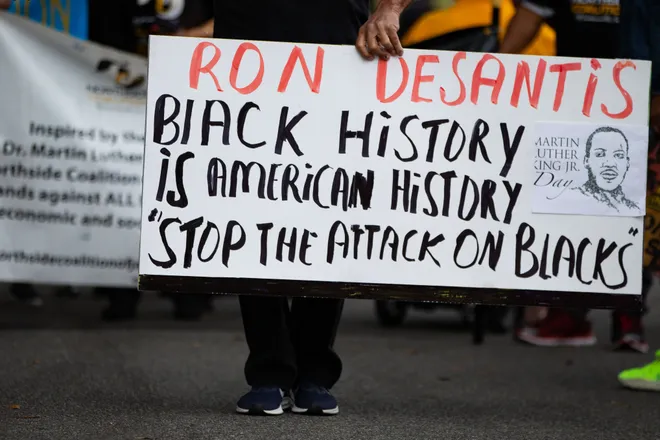
Feb. 28, 2024
Faith leaders, educators ask Florida officials to reconsider Black history standards
Feb. 25, 2024
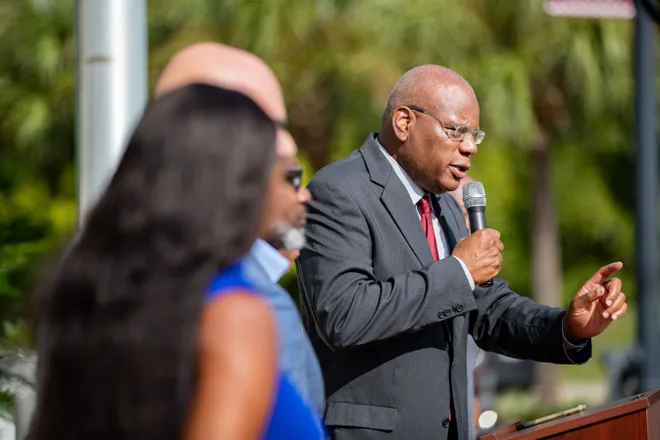
Rev. R.B. Holmes’ task force symposium: Crafting new Black history curriculum
Part V – The New World African (NWA) Forcibly Migrated to the USA in 1619.
- (Enslavement 1619 - Emancipation 1865)
- Captured/Sold - Where were the slave ports in West Africa that most enslaved people were captured and sold.
- Transatlantic Passage - Name the main ports in the US where African Slaves disembarked? Name the States that bought and sold enslaved African in the U.S.?
- Auctioned-Off and Resold– Where the main auctions took place (main auction blocks)?
- Slavery - The Economics of Slavery (e.g., rice, sugar, cotton, tobacco)
- Where were the largest plantations in the U.S.?
- Describe the life of an enslaved African in the US?
- Describe the life of an enslaved African n Florida?
- Were there any laws that protected the lives of the enslaved ?
- Were there different types of enslaved Africans ?
- What did the enslaved Africans have in common?
- What did the enslaved Africans have in common?
- What did the enslaved Africans suffer in common?
- Did their conversion to the master’s religion alleviate their misery?
- Could enslaved Africans worship in the same house of worship with their masters since they shared religion?
- Why were the enslaved Africans, in many instances, forced to be Christians but yet were forbidden to learn to read or write?
- Enslaved Africans Contributions
- Their roles in the Agricultural Revolution
- Impact of Enslaved Africans during the Industrial Revolution (beginning in 1793)
- Building the U.S.
- Phillis Wheatley – Famous poet and enslaved women. In 1773, she published her poems in a book and was freed the same year. Read her poems to General George Washington.
- Black Abolitionist Movement
- Frederick Douglass
- Black Women Abolitionists
- Harriet Tubman (Underground Railroad)
- Sojourner Truth
- Maria Stewart
- Frances Ellen Watkins Harper
- Sarah Mapps Douglass
- Free Blacks
- Black Militancy Movement
- Northern Black Churches in Anti-Slavery Movement
- Black Newspapers in the Anti-Slavery Movement
- Samuel Cornish
- John B. Russwurm
- Reverse Underground Railroad - Enslaved Africans Escaping from the US South to British Caribbean Islands
- Slave Resistance - Significant Enslaved African/Indentured Servant Rebellions
- Nathaniel Bacon’s Rebellion (1675)
- New York City Uprising (1712)
- Stono Rebellion (1739)
- Haitian Revolution (1791 - 1804)
- Gabriel Prosser Revolt (1800)
- Andry’s Rebellion (aka German Coast Uprising of 1811)
- Denmark Vesey Conspiracy (1822)
- Nat Turner (Southampton Insurrection - 1831)
- The Amistad Mutiny (1839)
- The Creole Mutiny (1841)
- White Counter-Resistance - Laws Maintaining Social, Economic, and Political Control
-
- Virginia enacted slave codes in 1639 - based on the 1661 English slave code employed in Barbados, which became model for Southern colonies
- Three-Fifths Compromise in the US Constitution (1787)
- The Fugitive Slave Act of 1793
- The Missouri Compromise (1820) and the Kansas-Nebraska Act of 1854
- The Fugitive Slave Act of 1850
- The Compromise of 1850
- Dred Scott v. Sandford (1857) - US Supreme Court case about the citizenship and rights of formerly enslaved African: Can a negro, whose ancestors were imported into this country, and sold as slaves, become a member of the political community formed and brought into existence by the Constitution of the United States, and as such become entitled to all the rights, and privileges, and immunities, guaranteed by that instrument to the citizen? Short answer: NO! This case was the impetus to the Civil War.
- Homestead Act of 1862
-
- Antebellum Race Riots (1829 - 1851)
- The Evolution of African/Black Education in the US
- a. Enslaved Africans Secretly Receiving an Education
- b. Free Blacks Receiving an Education
- i. The Establishment of Black Higher Education
- Cheyney University (PA) (Initially founded as The African Institute in February, 1837 and changed to the Institute for Colored Youth in April, 1837 by Quaker philanthropist, Richard Humphreys) - First Black educational institution in U.S. to train descendants of the African race to become teachers (not degree-granting). Some notable graduates, such as Bayard Rustin (openly gay civil rights activist), Ed Bradley (CBS journalist), William “Billy” Joe (professional football player and coach), and Robert Bogle (President of The Philadelphia Tribune newspaper)
- The Lincoln University (PA) (Initially founded as Ashmun Institute in 1854 by Presbyterian minister and abolitionist, John Miller Dickey, and a site of the Underground Railroad) - First 4-year, college degree-granting HBCU in the U.S. Began as an all-male college with notable graduates, such as Thurgood Marshall, Langston Hughes, Nmandi Azikiwe (first President of Nigeria), Kwame Nkrumah (first President of Ghana), and Roscoe L. Browne (actor). Became co-ed university admitting women in 1952 and a state-related institution in the Commonwealth of Pennsylvania in 1972.
- i. The Establishment of Black Higher Education
- Civil War (1861-1865)
- Reasons for Civil War
- Role of Black people fighting in the Civil War
- Civil War Race Riots (1863)
Part VI. Emancipation 1865 - Jim Crow 1896
- Abraham Lincoln issued the Emancipation Proclamation on January 1, 1863
- Emancipation for the Enslaved was on June 19, 1865 - The day the last enslaved Africans were informed they were free in Galveston, TX
- June 19, 1865, became known as Juneteenth, which President Joe Biden signed into law as a federal holiday in 2022.
- Reconstruction Period - 1866-1877 (First Civil Rights Movement)
- Freedmen’s Bureau Created in March, 1856
- Freedmen’s Bureau Act of 1865
- Freedmen’s Bureau Act of 1866
- January 16, 1865 - General William Tecumseh Sherman issued Field Order No. 15, which redistributed about 400,000 confiscated acres of land in Lowcountry Georgia and South Carolina in 40-acre plots to newly freed Black families. The Freedmen’s Bureau gave legal title for 40-acre plots to African Americans (i.e., 40 acres and a mule) and white southern unionists. President Andrew Jackson returned most of land to the former White slaveholders.
- Shaw University founded in 1865, first HBCU in the South
- The 13th Amendment to the Constitution ratified on December 6, 1865
marked the abolition of slavery in the U.S.; Did the formerly enslaved
Africans automatically become Americans? If not, what were they? - Black Codes in the South
- Civil Rights Act of 1866 – Became template for the 14th Amendment
- 4th Amendment to the Constitution ratified on July 9, 1868, granted citizenship; Did the formerly enslaved Africans become fully citizens with all the rights afforded to others? If not, what was missing?
- 15th Amendment to the Constitution ratified on February 3, 1870, granted the right to vote; were there obstacles for them to exercise that right? Was that right protected by the Federal Government?
- Reconstruction and post-reconstruction race riots (1866 - 1899)
- The Slaughterhouse cases (1873) - This was the U.S. Supreme Court’s
first interpretation of the 13th and 14th Amendments. The Court severely
narrowed the protection of the Privileges and Immunities Clause of the
14th Amendment to National citizenship rights instead of state rights.
The U.S. Supreme Court also interpreted the main purpose of the Equal
Protection Clause as protecting the rights of newly freed slaves, but it
limited the States’ requirement to protect Black people to individual
rights and reduced the protects race-based discrimination only, and made
newly freed Blacks defenseless - Civil Rights Act of 1875
- Black men holding political office
- Over 600 Black men held office in state legislators
- In 1875, Blanche Bruce, a Mississippian, was the first Black man to serve a full-term in the U.S. Senate
- Compromise of 1877
- Freedmen’s Bureau Created in March, 1856
- Educating the Formerly Enslaved
- Formerly enslaved Black people joined together, with help from abolitionists and Black people from the North, to create schools to educate themselves.
- Hampton Normal and Agricultural Institute was founded in 1868 – Booker T. Washington graduated from here. It later became Hampton University.
- Booker T. Washington took over administrative responsibilities at the Tuskegee Institute in 1881 to train Black people to become teachers. Tuskegee Institute later became Tuskegee University.
- Black Churches Support for the Formerly Enslaved in the South
- Black churches started opening in the South during and after Reconstruction - Became the home for political activism, location for educational hubs, and source of encouraging Black pride and race-consciousness.
- The Second Morrill of 1890 - Required the federal government to create land-grant higher education institutions for Black students. There are 19 land-grant HBCUs: Alabama A&M, Alcorn State University, Central State University, Delaware State University, Florida A&M University, Fort Valley State University, Kentucky State University, Langston University, Lincoln University of MO, North Carolina A&T State University, Prairie View A&M University, South Carolina State University, Southern University, Tennessee State University, Tuskegee University, University of Arkansas Pine Bluff, University of Maryland Eastern Shore, Virginia State University and West Virginia State University.
- Plessy v. Ferguson (1896) - Separate by Equal by Law (de jure segregation)
- Why and how did Reconstruction fail newly freed Blacks?
- Economic Opportunities and Wealth Denied
- Lack of Quality Education
Part VII. Jim Crow 1896 - Civil Rights Movement
- The Horror of the Jim Crow Era
- Separate-but-Equal - Segregating whites from non-whites in public and private spaces (e.g., schools, restaurants, hotels, parks, businesses, employment, housing, military etc.). Non-white people, particularly Black people due their historically recognized social and racial inferiority, were arrested, beaten, and even killed if they violated this legal practice.
- Racial violence and race riots (1900 - 1951)
- Atlanta Race Massacre (1906)
- Race Riots of 1919 (Red Summer)
- The Ococee, FL Massace (1920)
- Tulsa Race Massacre - Black Wall Street (1921)
- Rosewood, FL Massacre (1923)
-
Lynchings to terrorize and control Black people I. From 1882 to 1968, 4,743 lynchings occurred in the U.S., according to records maintained by NAACP. II. The highest number of lynchings during that time period occurred in Mississippi, with 581 recorded. Georgia was second with 531, and Texas was third with 493.
-
Eugenics Program and forced sterilizations of Black women (1929 – 1973)
-
The Tuskegee Syphilis Experiment (1932 – 1972)
-
Organizations and Black Activists Resisting Jim Crow and Discrimination
-
W.E.B. Du Bois - Author, civil rights activist, father of organized Pan-Africanism. 1900 - helped organize and showcase the Paris Exhibit. a. 1909 - co-founded the National Association for the Advancement of Colored People (NAACP). b. 1919 - organized the first Pan-African Congress
-
Development of NAACP in 1909 - Grew out of Black people discussing and wanting to address racial violence (i.e., lynchings) and defacto and de jure segregation)
-
Development of The National Urban League in 1910, formerly known as the National League on Urban Conditions Among Negroes
-
Madam C. J. Walker – First woman self-made millionaire
-
Made her wealth selling hair products and straighteners in the early 1900s-Walker Manufacturing Company
-
Employed and trained over 40,000 saleswomen and men in the U.S., Caribbean, and Central America
-
-
Role of the Black Church
-
The greatest growth of churches in America occurred between 1865-1905 due to the establishment of more than 30,000 Black churches with over 3 million members.
-
Theological battles about biblical history and interpretation was secondary to basic social injustices brought on by racism. The Black Church laid the foundation for the crusade that would transform into the Civil Rights Movement
-
Contributions of Black women to the church
-
Black missionaries traveling internationally.
-
-
Carter G. Woodson - American historian known as the “Father of Black History.” He founded the Association for the Study of Negro Life and History (ASALH).
-
Wallace Fard Muhammad found the Nation of Islam (1930)
-
The Julius Rosenwald Fund – A school building fund program for African American communities to build and supply schools for Black students between 1913 and 1932.
-
-
Great Migration - 1910
-
Black people moved from the South to Northern, Midwestern and Western states to escape racial violence, pursue economic and educational opportunities, and to escape Jim Crow oppression
-
Growth of the Black middle-class
-
-
Harlem Renaissance - 1920s - 1930s
-
Black Leadership in the Cultural and Artistic Revolution
-
Cotton Club
-
Apollo Theater in Harlem
-
-
A coming of age in which the social disappointments experienced through Jim Crow were transformed into racial pride.
-
The Harlem Renaissance included poetry, prose, painting, sculpture, jazz, swing, opera and dance.
-
Contributors:
-
Intellectuals - W. E. B. DuBois, Marcus Garvey, Walter C. White, Alain LeRoy Locke
-
Performers - Paul Roberson, Josephine Baker, Hattie McDonald, Billie Holiday, Marian Anderson
-
Poets and Writers - Langston Hughes, Zora Neale Hurston, Effie Lee Newsome, Paul Laurence Dunbar, Countee Cullen
-
Musicians - Louis Armstrong, Duke Ellington, Count Basie, Cab Calloway, W.C. Handy
-
-
The Cultural and Artistic Revolution occurred in Cleveland, Los Angeles, Detroit and other cities shaped by the Great Migration
-
-
World Wars
-
World War I - 1911 - 1914
-
The African American Infantry Unit
-
104 Black medical doctors volunteered to serve in WW 1. They cared for soldiers of all Black 92nd and 93rd Divisions. Most were graduates of Meharry Medical College, Howard University College of Medicine and Leonard Medical School at Shaw University in North Carolina.
-
-
World War II – 1941 - 1945
-
Tuskegee Airmen, 92nd Infantry Division (Buffalo Soldiers), Red Ball
-
The Armed Forces desegregated in 1948.
-
-
-
NAACP Legal Defense Fund, with Charles Hamilton Houston and Thurgood Marshall as lead attorneys, brought lawsuits challenging the separate-but-equal doctrine in higher education (legal cases from 1930s -1950)
-
University of Maryland v. Murray (1936).
-
Missouri ex rel. Gaines v. Canada (1938)
-
Sipuel v. Board of Regents of the University of Oklahoma (1948)
-
McLaurin v. Oklahoma State Regents for Higher Education, et al. (1950)
-
Sweatt v. Painter (1950)
-
Explain the humiliating aspects of Segregation and its impact on African American Economy, Diplomacy, Security, Informational and Immigration?
Part VIII. Civil Rights Movement
It started in the mid-20th Century as a national movement for equal rights to end segregation, exclusion, and oppression for Black People in the United States.
- Separate Cannot Be Equal – Desegregating schools.
- Brown v. Board of Education- The Supreme Court ruled unanimously on May 17, 1954 that “separate educational facilities were inherently unequal.” Thurgood Marshall was the lead attorney.
- Legally ended segregation in public schools in the United States
- Partially overturned the Plessy vs Ferguson ruling of 1896 (desegregation only in public education).
- Brown v. Board of Education II (1955) -Desegregate public schools with “all deliberate speed”
- What is the difference between “desegregation” and “integration?”
- School Desegregation
- Nine Black Students (The Little Rock Nine) desegregated Central High School in September 1957 in Little Rock, Arkansas.
- Ruby Bridges, age 6, was the first elementary school student to desegregate a former whites-only school, William Frantz Elementary School in Louisiana
- President Dwight D. Eisenhower ordered Federal Troops to keep the peace.
- Most school districts in the South refused to desegregate. Prince Edwards County Schools in Virginia passed a law to close public schools so Black children could not attend and to open private schools for white children that would be funded with vouchers (first school voucher programs grounded in racism). VA law found unconstitutional in 1959.
- Brown v. Board of Education- The Supreme Court ruled unanimously on May 17, 1954 that “separate educational facilities were inherently unequal.” Thurgood Marshall was the lead attorney.
- Martin Luther King, Jr. and the Nonviolence Movement
- Congress of Racial Equality (CORE) was founded by James L. Farmer, Jr., Bayard Rustin, George Houser, Bernice Fisher in 1942. CORE pioneered key tactics of the modern civil rights movement, using sit-ins and other forms of civil disobedience to challenge segregation.
- Emmett Till murder in Money, Miss. in 1955
- The murder brought attention to the racial violence and injustice in the South and galvanized and inspired the movement.
- Rosa Parks was arrested 100 days later in 1955 in Montgomery, AL for refusing to give up her seat to a white passenger.
- Led to Montgomery Bus Boycott
- Led to the rise of Rev. Dr. Martin Luther King’s prominence in the movement
- Led to the Tallahassee bus boycott in 1956
- Southern Christian Leadership Conference began in 1957 as an organization built on Christian principles of peaceful protest and nonviolence; MLK, Jr. was first president.
- Student Nonviolent Coordinating Committee (SNCC) Founded in 1960 by Ella Baker, Nash, Julian Bond, and others
-
Greensboro, NC Sit-Ins (1960)
-
Martin Luther King, Jr’s Letter from Birmingham Jail (1963)
-
The Birmingham Children’s Crusade (1963)
-
March on Washington (1963)
-
Dr. Ernest Withers, Sr. – Acclaimed photographer documenting the Civil Rights Movement (1950s – 1970s)
-
Civil Rights Movement and Racial Violence Escalates
-
Rise of the Nation of Islam under leadership of Elijah Muhammad and Malcolm X (1950s-1960s)
-
Freedom Rides (1961)
-
Ole Miss Riot of 1962 and James Meredith
-
Medgar Evers Assassination (1963)
-
The 16th Street Baptist Church Bombing in Birmingham, AL (1963)
-
Murder of President John F. Kennedy (1963)
-
Selma – Montgomery March for Voting Rights (Bloody Sunday) - 1965
-
Murder of Malcolm X (1965)
-
Watts Riots (1965)
-
Black Panthers Party Founded by Huey Newton and Bobby Seale (1966)
-
Detroit Riots (1967)
-
Orangeburg, SC Massacre (1968)
-
Memphis Sanitation Workers Strike (1968)
-
Murder of MLK, Jr. (1968)
-
Murder of Attorney General, Robert Kennedy (1968)
-
-
Civil Rights Laws and Actions
-
Civil Rights Act of 1964
-
No discrimination based on race, color, religion, sex, or national origin in education, hiring, firing, and promotions in public institutions or private institutions with more than 15 employees.
-
Title VI – Organizations receiving federal funding will lose the funding if they continue to discriminate and refuse to desegregate.
-
Title VII – Addressed discrimination in employment iv. Outlawed segregation in all public places (e.g., schools, restaurants, hotels, parks, etc.)
-
Federal Office for Civil Rights sent desegregation orders to schools and universities throughout the Nation
-
The Green Factors
-
Busing to desegregate schools
-
-
-
Affirmative Action Policies
-
Term “Affirmative Action” named explicitly as a legal order in President John F. Kennedy’s 1961 Executive Order 10952
-
directed contractors on projects funded with federal money to “take affirmative action to ensure that applicants are employed, and employees are treated during their employment, without regard to the race, creed, color, or national origin”
-
President Kennedy proposed legislation to implement a civil rights act
-
Established the Equal Employment Opportunity Commission (EEOC) and laid groundwork for Civil Rights Act of 1964.
-
Would not merely eradicate discrimination, but eradicates oppressive economic and social burdens imposed on Black people due to racial discrimination
-
Expand educational and employment opportunities
-
-
Voting Rights Act of 1965
-
Elementary and Secondary Education Act (ESEA) of 1965 - a key component of President Johnson's War on Poverty, was designed to aid low-income students and to combat racial segregation in schools.
-
President Lyndon Johnson appoints Thurgood Marshall to the U.S. Supreme Court in 1967. He was the first Black person to serve on the Court and served until 1991.
-
Loving v. Virginia (1967)
-
Fair Housing Act (1968)
-
Education Amendments of 1972
-
Title IX
-
-